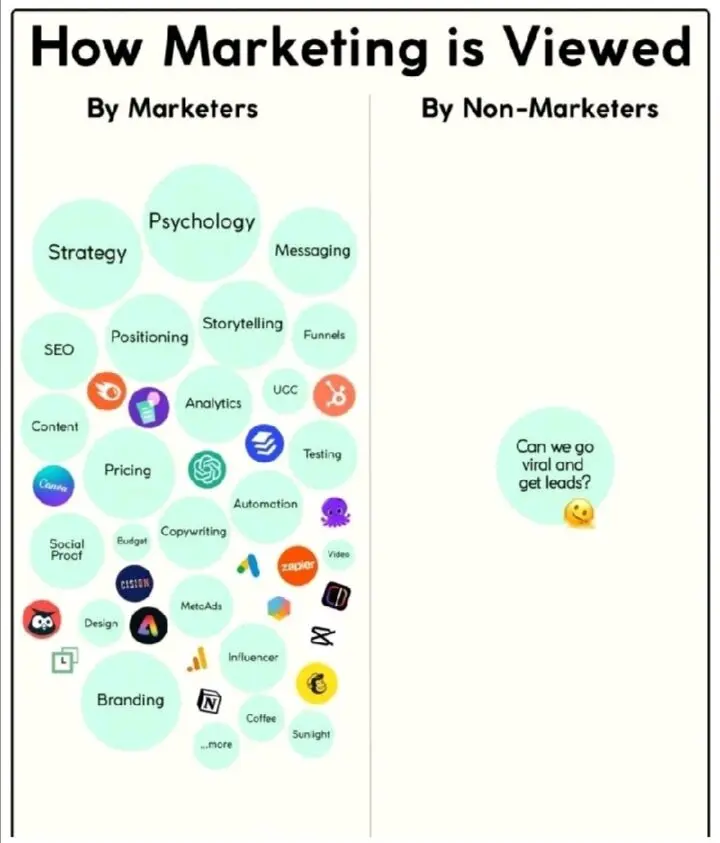
In the boardroom, the question usually sounds like this: “Can we just make something go viral?” or “How do we get 1,000 leads by Friday?”
To a non-marketer, marketing looks like a magic wand—a mix of luck, catchy slogans, and hitting a “big win” on social media. But to the professionals behind the scenes, marketing isn’t a gamble. It’s a sophisticated ecosystem of psychology, data, and deliberate storytelling.
While “going viral” is a fleeting spike in a graph, true marketing is the slow, steady build of trust that compounds over time.
The Iceberg Effect: What Marketers See vs. What Others Ask
Most people only see the tip of the marketing iceberg—the final ad, the clever tweet, or the glossy video. Beneath the surface lies a massive structure of disciplines that keep the brand afloat.
The Professional Marketer’s Toolkit
When a marketer looks at a campaign, they aren’t just looking for “likes.” They are orchestrating a symphony of:
- Psychology: Understanding cognitive biases, emotional triggers, and why humans make the decisions they do.
- Strategy: The “North Star” that ensures every dollar spent aligns with long-term business goals.
- Messaging & Storytelling: Distilling complex value propositions into narratives that resonate on a human level.
- SEO & Content: The art of being discovered by the right person at the exact moment they have a problem.
- Analytics & Testing: The cold, hard science of measuring what works, killing what doesn’t, and iterating constantly.
- Automation: Building systems that nurture relationships while the team sleeps.
- Branding: The gut feeling someone has about your company—the intangible “soul” of the business.
Why “Viral” is a Dangerous Goal
The obsession with virality is the “get rich quick” scheme of the business world. It’s seductive because it promises massive results for minimal effort. However, virality has three major flaws:
- It’s Not Scalable: You cannot reliably predict what the internet will decide to share tomorrow. Basing a business model on virality is like basing a retirement plan on winning the lottery.
- It Attracts the Wrong Audience: A viral video might get 5 million views, but if 4.9 million of those viewers aren’t your target customer, you haven’t built a business; you’ve just hosted a very crowded party.
- It Fades: Viral spikes have a short half-life. Once the dopamine hit wears off, users move on to the next trend.
Trust, on the other hand, compounds. A customer who trusts you because you’ve consistently solved their problems is worth a thousand “likes” from strangers.
Marketing is Human Behavior (The Psychology)
At its core, marketing is the study of human behavior. It’s about understanding the friction points in a person’s life and offering a bridge to a better version of themselves.
- The Power of Reciprocity: Giving away value (like SEO-driven educational content) before asking for a sale.
- Social Proof: Using testimonials and case studies to prove that others have already taken the risk and succeeded.
- Loss Aversion: Highlighting what a customer stands to lose by not acting.
When you stop trying to “hack the algorithm” and start trying to “help the human,” your marketing shifts from noise to signal.
The Science of Growth: Testing and Analytics
If storytelling is the heart of marketing, analytics is the brain. Modern marketing is a rigorous cycle of hypothesis and experimentation.
| Feature | The “Viral” Approach | The Scientific Approach |
| Goal | Maximum reach | Maximum ROI & Retention |
| Method | Trend-jacking | A/B Testing & Data Analysis |
| Sustainability | Low (One-hit wonder) | High (Iterative growth) |
| Feedback Loop | Vanity metrics (Likes/Shares) | Conversion rates & Customer Lifetime Value (CLV) |
Through Automation and Testing, marketers can determine the exact message that resonates with a specific segment of the audience. We don’t guess; we measure.
Building a Narrative: Messaging and Storytelling
People don’t buy products; they buy better versions of themselves. This is where Storytelling and Messaging become your most potent weapons.
A great story does three things:
- Identifies the Hero: (Spoiler: It’s the customer, not your brand).
- Defines the Villain: The problem, the inefficiency, or the frustration the customer faces.
- Offers a Guide: Your brand, providing the plan and the tools to win the day.
When your Branding is consistent across your Content and SEO efforts, you create a seamless experience that feels less like “being sold to” and more like “being understood.”
Conclusion: Marketing is Deeper Than You Think
The next time you’re tempted to ask, “How do we get more leads?”, try asking, “How do we build more trust?”
Marketing is a marathon, not a sprint. It’s the intersection of art and science, empathy and data. While the “non-marketer” looks for the shortcut, the “marketer” builds the road.
Viral fades. Trust compounds. Which one are you building?